


“How long,” they say, “how long, O cruel nation,
Will you stand, to move the world, on a child’s heart…
—The Cry of the Children
E. B. BROWNING (1843)
Part 1: Against the Machine
I.
In his book, Against the Machine, Paul Kingsnorth warns that there is a spiritual crisis at the heart of modern society. We have been uprooted from God, nature and culture by ‘the Machine’:
The ultimate project of modernity, I have come believe, is to replace nature with technology, and to rebuild the world in purely human shape, the better to fulfill the most ancient human dream: to become gods. What I call the Machine is the nexus of power, wealth, ideology and technology that has emerged to make this happen.
The god of the self and his faithful servant, technology, can increasingly give us exactly what we want at any given moment … salvation is approaching: and this time, we are in control.
Paul Kingsnorth is not the first writer to sound the alarm on the spiritual cost of technological change and so-called Progress.
After the invention of the printing press, Johannes Trithemius wrote a treatise in the 1400s titled ‘In Praise of Scribes’ about the spiritual value of carefully copying out the Bible by hand, in a day when printing could do the job in seconds:
[The writer,] while he is writing on good subjects, is by the very act of writing introduced in a certain measure into the knowledge of the mysteries and greatly illuminated in his innermost soul; for those things which we write we more firmly impress upon the mind…While he is ruminating on the Scriptures he is frequently inflamed by them.
In 1811, writer Hannah More worried that novels (a fairly new genre in her day) were stimulating young girls’ imaginations, to the neglect of their judgment:
…real knowledge and real piety, though they may have gained in many instances, have suffered in others from that profusion of little, amusing, sentimental books with which the youthful library overflows … the corruption occasioned by these books has spread so wide, and descended so low, as to have become.one of the most universal, as well as most pernicious sources of corruption among us.
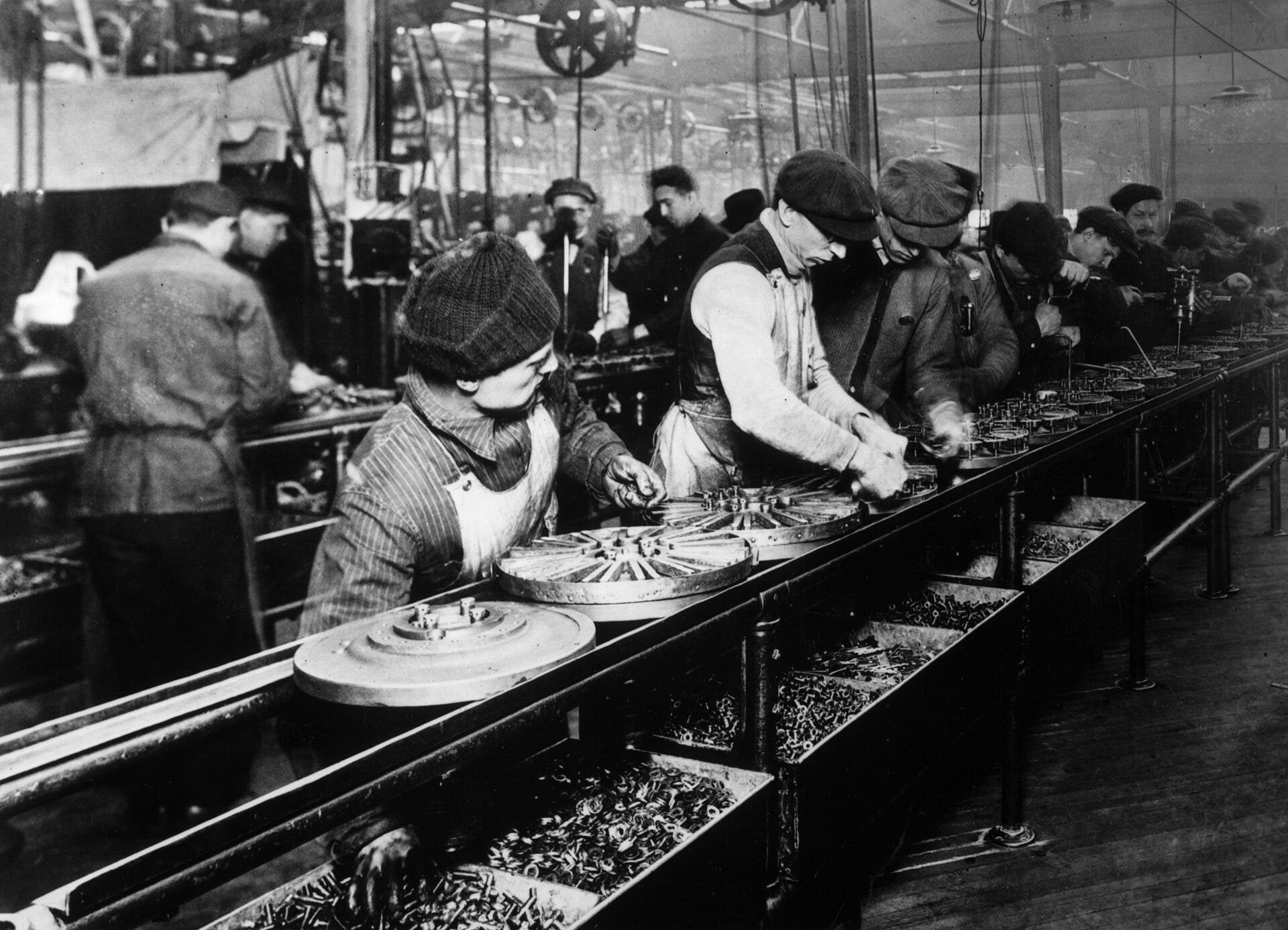
In The Stones of Venice, nineteenth-century art critic John Ruskin was concerned that industrialisation was reducing man to a mere cog in the machine:
We have much studied and much perfected, of late, the great civilized invention of the division of labour; only we give it a false name. It is not, truly speaking, the labor that is divided; but the men: Divided into mere segments of men—broken into small fragments and crumbs of life…
In an 1889 issue of Nature magazine, journalist Charles Hallock feared the intrusion of electricity into the home:
When Benjamin Franklin first called down the lightning from the sky he was accused by the superstitious or reverential with “tempting the Almighty.” Now we handle the subtile element as if it were inert matter, and we impress it into our nurseries as a toy for the children!
… The telephone is the most dangerous of all because it enters into every dwelling. Its interminable network of wires is a perpetual menace to life and property.
II.
Despite all these warnings, the project of Progress continued.
By 1920, Cities were powered by electricity, automobiles and telephones were invented, while there was a major shift in the market to mass production in factories.
By 1945, Radio, cinema and the electric grid connected the masses into the same cultural system.
By 1965, innovations had multiplied: television, antibiotics, jet aircraft, nuclear power, plastics, the first computers…
By 1990, personal computers had arrived, satellites had launched, and early digital networks began to replace information-processing work.
In the period 1990–2007, the Network emerged. The Internet opened the door to email and search, e-commerce and mobile phones. Machines became connected and we suddenly had access to the world of data.
Through the 2010s, the Internet became more and more ambient – no longer somewhere we went to find information, but something that surrounded us. Increasingly, we did not have to search for information, it was fed to us according to our preferences. All this was made possible by the development of smartphones, social media, cloud platforms, streaming, apps and algorithms.
Into the 2020s, and the machine gained apparent intelligence, with the discovery of Generative AI. And in the last couple of years, it has become increasingly autonomous. Agents and robots are here.
The project is not done, either. Man’s foot is firmly planted on the accelerator.
Exhibit A (from the venture capital firm, A16z):
III.
As a member of the first generation to experience dial up internet, WiFi, social media, and now AI, I have enjoyed many of the benefits. But I have also felt the spiritual loss, that so many, like Paul Kingsnorth, have warned us about.
Haven’t we all?
The feeling of being ‘screened’ out after a day spent at the computer. Or the feeling of discontent, after spending too long in a doomscroll. We have never had so much stuff, yet never been so anxious, so unhappy. Peace and joy are rare possessions in modernity. We all know the headlines about mental health, loneliness, suicides, pornography, online gambling, violence against women, the ‘lost boys’, and so on.
So what can we do?
Part 2: The Task at Hand
I.
We could spend all day debating whether technological progress is good or bad. The reality is this: Mankind will always be building Babel, unless God stops him.
What we can do is examine the influence that technology is having over us. We can stop letting the Machine dominate and distract us. Perhaps, most urgently, we need to understand how to wisely handle our latest innovation, AI.
And though I can’t change society, I can influence my family.
II.
Yes, there is cause for real concern, but we’re not doomed. God raises men for their own generation. The age of Machines, from a Christian point of view, is just a new scene in which believers will glorify God in this fallen world.
As with every past age, so it will be in this present era, and any times to come: there will be men and women who learn to live good, godly lives, despite all that is against them.
Good men have already learned to use the printer, without forgetting the value of writing things out by hand. They have bought novels and enjoyed the stories, without forgetting to cultivate their judgment. They have used the telephone and then the smartphone, but have learned to guard the intimacy and privacy of their closest relationships.
In the same way, there will be good men who will make use of our latest invention – artificial intelligence, but will not stop thinking. They will be men who will not be controlled by it, nor deceived.
III.
The question then, and the one that I’ve been thinking about is one of formation: how do we become such men and women, whose souls survive the ever accelerating advance of the Machine?
And how do we help our children live good lives, full lives for God, among the masses, surrounded by technology, connected to the wide world, bombarded with the gospel of Progress?
In future essays, I want get practical about how we can guard and cultivate our inner life (and our children’s) in the modern world. I want to understand how technology, especially AI, threatens some of the deepest human capacities we have: such as attention, imagination, desire, judgement and agency.
Thanks for reading,
Stephen